
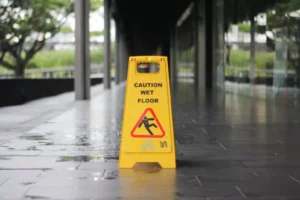
Texas makes an injured person prove a lot in a premises case. It isn’t enough that you fell on a wet floor in a grocery store or tripped on a broken stair at an apartment complex. You have to show the owner knew about the hazard, or that it had been there long enough that the owner should have found it, and that the owner didn’t fix it or warn you. That second part is where most slip and fall claims live or die, and it’s usually proven with the store’s own video and records. Those records belong to the business, and some of the video gets recorded over in days. If you were hurt on someone else’s property in Houston, what happens in the first week often decides the case.
Call (713) 664-4000. The consultation is free, and there’s no fee unless we recover for you. If we don’t recover, you don’t owe us for case expenses either.
What you have to prove
Most people hurt at a store, restaurant, apartment complex or office are invitees (if you were hurt at your own job, different rules apply), and the owner owes them the highest duty. To win, the injured person has to prove the owner had actual or constructive knowledge of a condition, the condition posed an unreasonable risk of harm, the owner didn’t use reasonable care to reduce or eliminate it, and that failure caused the injury (Keetch v. Kroger Co., 845 S.W.2d 262 (Tex. 1992)).
Constructive knowledge is the fight. The Texas Supreme Court has held that showing a hazard was near an employee isn’t enough on its own. Unless the store made the mess itself or an employee actually saw it, there has to be evidence of how long it was there, so the jury can decide whether the owner should have found it (Wal-Mart Stores, Inc. v. Reece, 81 S.W.3d 812 (Tex. 2002)). That’s why the surveillance video, the incident report, the cleaning and inspection logs, and the employees who worked that shift matter so much. And a store doesn’t have to warn you about, or fix, a danger that’s open and obvious or that you already knew about, except in narrow situations, like when you had no choice but to use it (Austin v. Kroger Texas, L.P., 465 S.W.3d 193 (Tex. 2015)).
Who you were on the property matters
| Your status | Example | What the owner owed you |
|---|---|---|
| Invitee | A customer, a hotel guest, a tenant in a common area, a hospital visitor | Reasonable care to make the property safe or warn of dangers the owner knew or should have known about |
| Licensee | A social guest at someone’s house | A warning about, or a fix for, dangers the owner actually knew about and you didn’t, and no gross negligence |
| Trespasser | Someone with no permission to be there | Only not to injure you on purpose or through gross negligence, with more protection for young children hurt by a man-made hazard, like an unfenced pool, that they’re too young to understand |
| Government property | A city sidewalk, a county building | Usually only the licensee duty unless you paid to use it, though a road hazard like an excavation or obstruction gets more protection. Written notice is due within six months, and against the City of Houston it’s due within 90 days (Civil Practice and Remedies Code §§ 101.022, 101.101; Houston City Charter art. IX, § 11) |
Other rules can change the duty too. If you were hurt doing something recreational, like swimming or hiking, on public land or on private land you didn’t pay to use (and sometimes even if you did), the recreational use statute gives you only the protection owed a trespasser. That means proving gross negligence, or that the owner acted in bad faith or with malicious intent (§§ 75.002, 75.003). And if you’re a contractor, or work for one, and got hurt building or repairing something on commercial property, you have to prove two things: the owner kept some control over how the work was done, and the owner actually knew about the danger and didn’t adequately warn you (§ 95.003).
The cases we handle
We handle slip and falls on spills and wet floors, trip and falls on broken sidewalks, stairs, curbs and parking lots, falling merchandise, apartment and hotel injuries from broken railings or unsafe balconies, and swimming pool injuries. We also handle negligent security cases, where a property owner who knew about earlier crimes on or near the property didn’t provide the lighting, gates, locks or security that could have prevented an assault or shooting. Those cases turn on whether the crime was foreseeable, which Texas courts measure by how close, how recent, how frequent, how similar and how well known the earlier crimes were (Timberwalk Apartments, Partners, Inc. v. Cain, 972 S.W.2d 749 (Tex. 1998)).
What we do first
We send a preservation letter the same week, demanding the property owner keep the video, the incident report, the inspection and cleaning logs, and the names of the employees on duty. If a business destroys evidence on purpose, or lets it be erased when it knew the evidence mattered, a Texas judge can tell the jury to presume the missing evidence would have hurt the business. The Texas Supreme Court set that standard in a grocery store slip and fall where the store saved only about eight minutes of video and let the rest be erased (Brookshire Bros., Ltd. v. Aldridge, 438 S.W.3d 9 (Tex. 2014)). That’s why our letter goes out the same week. We photograph the scene before it’s fixed and find the witnesses. Your medical care needs to be documented from the first visit, and we make sure it is. And we deal with the property owner’s insurer, which will almost always argue the hazard was obvious or that you weren’t watching where you were going.
Texas uses proportionate responsibility, so if a jury finds you more than 50 percent at fault, you recover nothing (§§ 33.001, 33.012). You generally have two years to file suit (§ 16.003). If a family member died from a fall or an assault on someone else’s property, see our page on wrongful death. For what the legal elements look like in a fall case, see what you need to prove in a Texas slip and fall case.
Hurt on someone else’s property in Houston? Call Blass Law
Jay Blass Cohen was born and raised in Houston and has practiced here since 2009. We move fast on the evidence that the property owner controls, and we prepare every case as if it’s going to trial.
Call (713) 664-4000. If you were hurt this week, call now, before the video is gone.
Real Results for Our Clients
Prior results do not guarantee a similar outcome. See all case results →
Related Personal Injury Practice Areas
- Houston Personal Injury Lawyer (Overview)
- Car Accident Lawyer
- Truck Accident Lawyer
- Drunk Driving Accident Lawyer
- Rideshare, Lyft & Uber Accident Lawyer
- Maritime & Admiralty Accident Lawyer
- Wrongful Death Lawyer
- Medical Malpractice Lawyer
- Product Liability Lawyer
- Bicycle Accident Lawyer
- Catastrophic Injury Lawyer
- Burn Injury Lawyer
- Construction and Workplace Injury Lawyer
- Settlements & Verdicts
Frequently Asked Questions
- What Do I Need to Prove in a Texas Slip and Fall Case?
- What Is My Legal Status as a Visitor and Why Does It Matter?
- Can I Sue a Business for a Slip and Fall Even Without a Written Incident Report?
Reviewed by Jay Blass Cohen, founder of Blass Law PLLC, ACS-CHAL Forensic Lawyer-Scientist, certified Drug Recognition Expert, and SFST instructor, serving Houston since 2009. This article is general information, not legal advice for your situation. Prior results do not guarantee a similar outcome.