
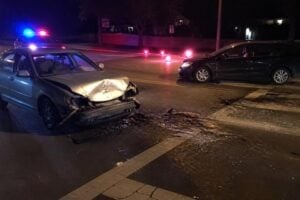
Intoxication assault is a DWI crash where someone suffered serious bodily injury, and it’s a third-degree felony with 2 to 10 years in prison and up to a $10,000 fine (Penal Code §§ 49.07, 12.34). Deferred adjudication isn’t available at all (Code of Criminal Procedure Art. 42A.102(b)(1)(A)). If you get probation, at least 30 days in jail is a mandatory condition. And prosecutors often ask for a finding that the car was a deadly weapon, which takes probation away from the judge. But the State has to prove more than a crash and a breath or blood result. It has to prove the injury was serious bodily injury, and that the injury happened because you were intoxicated, not just because you were driving when a crash happened.
Call (713) 664-4000. Don’t talk to the other driver’s insurer or the police about the crash before you talk to us.
What the State has to prove
Intoxication. A 0.08 alcohol concentration, or not having the normal use of your mental or physical faculties because of alcohol or any other substance, including a legal prescription (§§ 49.01(2), 49.10).
Serious bodily injury. Not just a painful or visible injury. The statute requires an injury that creates a substantial risk of death, or causes serious permanent disfigurement or protracted loss or impairment of the function of a body part or organ (§ 49.07(b)). A broken bone that heals normally is often argued both ways. The medical records usually win or lose this element, and we get all of them.
Causation. The injury has to happen “by reason of that intoxication.” If the other driver ran the light or turned in front of you, the crash may have happened the same way with a sober driver. The State will argue a sober driver would have reacted in time. But if the other driver’s conduct was clearly enough to cause the crash by itself, and your intoxication clearly wasn’t, the law says you’re not responsible for the injury (Penal Code § 6.04(a)). Crash reconstruction, the vehicles’ event data recorders, witness statements and intersection video are how we prove it.
Penalties
| Circumstance | Level |
|---|---|
| Serious bodily injury to another person | Third-degree felony, 2 to 10 years |
| Serious bodily injury to an on-duty firefighter or EMS worker, or a traumatic brain injury causing a persistent vegetative state | Second-degree felony, 2 to 20 years (§ 49.09(b-1), (b-4)) |
| Serious bodily injury to an on-duty peace officer or judge | First-degree felony, 5 to 99 years or life (§ 49.09(b-1)) |
A deadly weapon finding changes the case more than the grade does. With that finding, only a jury can recommend probation, and only if the sentence is 10 years or less and you’ve never been convicted of a felony (Art. 42A.054(b), 42A.055, 42A.056). A prison sentence with a deadly weapon finding also means serving at least half of it in actual calendar time, with no good-time credit and never less than two years, before you’re even eligible for parole (Gov’t Code § 508.145(d)). An intoxication assault conviction also counts as a prior DWI for the rest of your life. The next DWI becomes a Class A misdemeanor with at least 30 days in jail, and one more after that is a felony (§ 49.09(a), (b), (c)). If someone died, the charge is intoxication manslaughter.
The blood draw
After a crash with serious injuries, officers in Houston almost always get your blood. If you’re arrested and refuse, Texas law says they have to take it (Transportation Code § 724.012(a-1)). But that law doesn’t let them skip the warrant. The Court of Criminal Appeals held that the mandatory blood draw statute doesn’t justify a warrantless draw on its own (State v. Villarreal, 475 S.W.3d 784 (Tex. Crim. App. 2014)), and since 2021 the statute itself requires a warrant or real exigent circumstances (§ 724.012(e)). Without a warrant or valid consent, the State has to show a real emergency made getting a warrant impractical. If it can’t, the blood result can be suppressed. Even then, prosecutors often subpoena the hospital’s own blood test, and we fight that too. When there is a warrant, we look at the warrant affidavit, who drew the blood, how long after the crash it was drawn and what the lab did with it. Jay Blass Cohen is an ACS-CHAL Forensic Lawyer-Scientist trained in forensic chromatography, and blood alcohol analysis is exactly what that training covers.
How we defend intoxication assault
We start with the crash, not the DWI investigation. That means getting to the scene evidence before it’s gone: the vehicles, their event data, nearby video and the 911 calls. Then we look at the medical records to see whether the injury actually meets the statute, and at the timeline to see whether the intoxication evidence holds up. Jay is also a certified instructor in the standardized field sobriety tests and a certified Drug Recognition Expert, which matters because post-crash field sobriety tests are given to people who were just in a wreck, often injured and in shock. See our Houston DWI defense page for more on how we challenge the DWI evidence.
Results
A Harris County client accused of striking a pedestrian after leaving White Oak Music Hall, with a blood result of 0.086 that was also positive for cocaine and THC, had the DWI dismissed. A Harris County jury found a commercial driver not guilty of DWI after a crash in which he failed the field sobriety tests at the scene and at the station. See more of our case results. Prior results do not guarantee a similar outcome.
Charged with intoxication assault in Houston? Call Blass Law
Jay Blass Cohen has defended DWI and intoxication cases in Houston since 2009 and has never worked for the prosecution. The evidence in a crash case disappears fast, so the sooner we’re involved, the more of it we can save.
Call (713) 664-4000. If the crash just happened, call today, before the vehicles are repaired or salvaged.
Reviewed by Jay Blass Cohen, founder of Blass Law PLLC, ACS-CHAL Forensic Lawyer-Scientist, certified Drug Recognition Expert, and SFST instructor, serving Houston since 2009. This article is general information, not legal advice for your situation. Prior results do not guarantee a similar outcome.