
A second DWI in Texas is a Class A misdemeanor. If the judge sentences you to jail, it’s 30 days to a year, and 30 days is the floor. The fine can go up to $4,000 (Penal Code § 49.09(a)). Probation is possible, but it carries its own mandatory jail time. There’s no lookback period, so a first DWI from 20 years ago still counts, and so does a DWI deferred adjudication. And the option that resolves a lot of first DWIs isn’t available: deferred adjudication is barred for any DWI that can be enhanced with a prior (Code of Criminal Procedure Art. 42A.102(b)(1)(C)). Any plea to DWI on this case, even one knocked down to a first offense, leaves a record that can’t be expunged. And because you already have a prior, it can’t be sealed either. That’s why we prepare these cases for trial from the first day, and why the prior itself is one of the first things we attack.
Call (713) 664-4000. You have 15 days to request the license hearing, and the clock usually starts the day of the arrest. The bond conditions on a second DWI kick in long before any conviction.
What happens right after a second DWI arrest
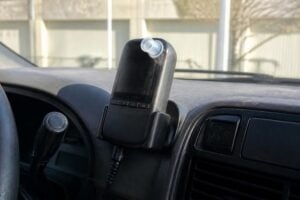
On a subsequent DWI, the magistrate has to order an ignition interlock as a condition of bond (Code of Criminal Procedure Art. 17.441). The device goes on your car before there’s any conviction, and it stays on while the case is pending unless the magistrate finds that requiring it would not be in the best interest of justice. You have 30 days from release to get it installed. Your license also faces a separate administrative suspension. If you had an alcohol- or drug-related enforcement contact in the 10 years before this arrest, it’s a year for a failed test or two years for a refusal, instead of 90 or 180 days. You only get a hearing on it if you ask within 15 days. See our page on the ALR hearing.
Penalties for a second DWI
| Consequence | Second DWI |
|---|---|
| Jail | 30 days minimum, up to 1 year |
| Fine | Up to $4,000, plus a separate state fine of $3,000 on conviction. That jumps to $4,500 if this is your second DWI conviction within 36 months, or $6,000 if a test showed 0.15 or more. The judge has to waive the state fine if you’re indigent (Transp. Code § 709.001) |
| License suspension on conviction | 180 days to 2 years, and at least 1 year if this arrest came within five years of the date of your earlier DWI offense (Transp. Code § 521.344) |
| Ignition interlock | Required on bond and as a condition of probation (Art. 17.441, 42A.408(c)) |
| Probation | Available, but with at least 72 hours in jail as a condition, or 5 days if this offense came within five years of the earlier one (Art. 42A.401) |
A child passenger under 15 isn’t an enhancement. It’s a separate state jail felony, prior or not (§ 49.045). And a third DWI is a third-degree felony. A conviction on this case sets that up.
Attacking the prior
The State has to plead the prior and prove it, including proof that you’re the same person named in the old judgment. That’s not always easy with an old case. Fingerprints are missing from some judgments, names get spelled differently, some records didn’t survive, and a prior plea without a lawyer needs a valid waiver of counsel to count. Out-of-state DUI convictions count if that state’s law prohibits driving while intoxicated. But the State still has to prove the out-of-state judgment is final and that it’s yours, and old out-of-state records are often where its proof is thinnest. If the prior can’t be used, the case drops to a first DWI. There’s no 30-day minimum, and deferred adjudication is back on the table as long as the test came in under 0.15 and you don’t hold a commercial license.
Attacking the new arrest
The stop. If the officer didn’t have reasonable suspicion to pull you over, the evidence that came from that stop can be suppressed (Code of Criminal Procedure Art. 38.23).
The field sobriety tests. Jay Blass Cohen is a certified instructor in the standardized field sobriety tests and a certified Drug Recognition Expert. He trains people on how these tests are supposed to be given, so he knows what a bad administration looks like on the video.
The breath or blood test. Jay is an ACS-CHAL Forensic Lawyer-Scientist trained in forensic chromatography. We read the breath instrument’s maintenance records and the blood lab’s raw data, not just the number on the report.
The video. Body camera and dash camera footage is where a report and reality part ways. We compare them line by line.
Results in second-offense DWI cases
A Harris County client charged with DWI second, resisting arrest and unlawful carrying of a weapon, with a 0.201 blood test, had every charge dismissed. Another Harris County client charged with DWI second and possession of a controlled substance had both dismissed in the middle of trial. A Fort Bend County jury found a client not guilty of DWI second (with co-counsel). And a Harris County DWI second with a 0.164 blood test after a rear-end crash was reduced to a first offense. See more of our case results. Prior results do not guarantee a similar outcome.
Charged with a second DWI in Houston? Call Blass Law
Jay Blass Cohen has defended DWI cases in Houston since 2009 and has never worked for the prosecution. On a second DWI, a conviction is permanent and the next one is a felony, so we look at every way to beat the prior and the new arrest before anyone talks about a plea. For more, see our pages on second DWI penalties in Texas and Houston DWI defense.
Call (713) 664-4000. The 15-day deadline for the license hearing usually starts the day you’re arrested.
Reviewed by Jay Blass Cohen, founder of Blass Law PLLC, ACS-CHAL Forensic Lawyer-Scientist, certified Drug Recognition Expert, and SFST instructor, serving Houston since 2009. This article is general information, not legal advice for your situation. Prior results do not guarantee a similar outcome.