
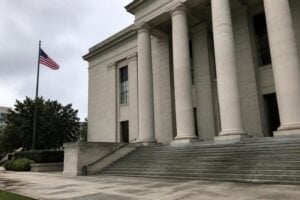
A federal case in Houston goes through the U.S. District Court for the Southern District of Texas at the Bob Casey Courthouse at 515 Rusk in downtown Houston, and it runs on different rules than a Harris County case. Many federal drug and child exploitation charges carry mandatory minimum sentences, and there’s no parole in the federal system. And most of the damage in a federal case happens before an indictment, when agents are still gathering evidence and asking to “just talk.” If an agent has contacted you, or you’ve received a target letter, the time to hire a lawyer is now.
Call (713) 664-4000. Don’t call the agent back, and don’t answer questions at your door. Say you have a lawyer and that we’ll be in touch.
Federal cases are part of our broader Houston criminal defense practice, and the work starts well before any indictment.
How federal cases differ from state cases
| Harris County (state) | Federal (Southern District of Texas) | |
|---|---|---|
| Who investigates | HPD, the Sheriff’s Office, DPS and the constables | FBI, DEA, ATF, HSI, IRS, the Secret Service, inspectors general |
| How a felony is charged | Grand jury indictment, often after an arrest | Grand jury indictment, unless you waive it and plead to an information, often after a long investigation |
| Sentencing | A statutory range the judge or jury picks within | Advisory Sentencing Guidelines, plus mandatory minimums set by statute |
| Parole | Available for most offenses | None. Good-conduct credit is capped at 54 days per year of the sentence, and First Step Act credits can shorten custody further for eligible people |
| Release before trial | Bail set by a magistrate. A judge can deny bail in some felony cases, and a 2025 constitutional amendment added more violent and sex offenses to that list | Detention hearing under the Bail Reform Act. Most drug trafficking and § 924(c) cases start with a presumption of detention, and so do many child exploitation cases |
Sources: 18 U.S.C. §§ 3142 and 3624(b); United States v. Booker, 543 U.S. 220 (2005).
The same conduct can sometimes be charged by both governments. Under Gamble v. United States, 139 S. Ct. 1960 (2019), a state case and a federal case over the same act don’t violate double jeopardy, which is one reason a Harris County drug or gun arrest can turn into a federal indictment months later.
The investigation is where federal cases are won or lost
Federal cases are usually built slowly, with subpoenas, search warrants, wiretaps and cooperating witnesses, and the people being investigated often know or suspect it. Agents commonly ask for a voluntary interview before anyone is charged. Nothing about that interview is voluntary in the way it sounds. Lying to a federal agent about anything that matters to the investigation is a separate crime under 18 U.S.C. § 1001, punishable by up to five years, or up to eight in sex offense investigations, and a lot of federal cases are proven with the defendant’s own interview.
A target letter from the U.S. Attorney’s Office means prosecutors consider you a likely defendant. It’s also an opening. Before an indictment, a lawyer can put information in front of the prosecutor that changes the charging decision, and in some cases negotiate a resolution before anything is filed. Once a grand jury returns an indictment, most of those options are gone.
If the government offers a proffer, a meeting where you tell prosecutors what you know under a limited-use agreement, it needs a lawyer who has read the agreement line by line. Proffer agreements protect less than people assume, and what you say can still be used to find other evidence against you.
Federal charges we defend
Drug trafficking and conspiracy. Above certain quantity thresholds, 21 U.S.C. § 841(b)(1) sets a 5-year or 10-year mandatory minimum, and prior drug convictions or a death or serious injury push it higher. A conspiracy charge under § 846 carries the same penalties and can hold one person responsible for quantities other people handled, but in the Fifth Circuit only the amounts that were part of what he agreed to and reasonably foreseeable to him. That limit is often where the fight is. The safety valve in 18 U.S.C. § 3553(f) lets some defendants be sentenced below the minimum.
Weapons charges. Felon in possession under 18 U.S.C. § 922(g) is the most common, and a gun used or carried during and in relation to, or possessed in furtherance of, a drug trafficking crime or crime of violence under § 924(c) adds a mandatory minimum of at least five years that has to run consecutively to everything else.
Fraud and money laundering. Wire fraud, health care fraud, bank fraud and money laundering cases turn on documents and on what the government can prove you knew. Guideline sentences in these cases are driven largely by the loss amount, so fighting over that number often matters as much as fighting over guilt.
Child exploitation offenses. Receiving or distributing child pornography under 18 U.S.C. § 2252A carries a five-year mandatory minimum, and online enticement of a minor under § 2422(b) carries ten. These cases are built on digital forensics, and the defense has to be too.
Obstruction and false statements. Sometimes the charge isn’t the underlying conduct at all. It’s something said to an agent or done after the investigation started.
Sentencing and the plea decision
Most federal cases end in a plea, and the plea agreement shapes more than people realize: which counts, what drug quantity or loss amount the government will argue for, whether it agrees the safety valve applies, and whether it will file for a reduction for substantial assistance. The advisory Guidelines range is calculated by the probation office in a presentence report, and objections to that report are where a lot of sentencing fights happen. We read every line of it, because a two-level increase can mean years.
Some cases should be tried, and federal juries acquit when the government’s cooperators don’t hold up. Whether to plead or try the case is your decision, and you should make it knowing what the evidence looks like and what the Guidelines actually say.
Under federal investigation in Houston? Call Blass Law
Jay Blass Cohen has defended criminal cases in Houston since 2009 and has never worked for the prosecution. He’s an ACS-CHAL Forensic Lawyer-Scientist trained in forensic chromatography, which matters in federal drug cases where the lab result sets the quantity and the quantity sets the sentence. We’ll tell you on the first call where you stand and what we’d do before the government’s next move.
Call (713) 664-4000. If agents have already been to your home or office, call today.
Federal charge pages
- Federal Drug Charges
- Federal Weapons Charges
- Federal Fraud
- Federal Money Laundering
- Obstruction of Justice
Reviewed by Jay Blass Cohen, founder of Blass Law PLLC, ACS-CHAL Forensic Lawyer-Scientist, certified Drug Recognition Expert, and SFST instructor, serving Houston since 2009. This article is general information, not legal advice for your situation. Prior results do not guarantee a similar outcome.