
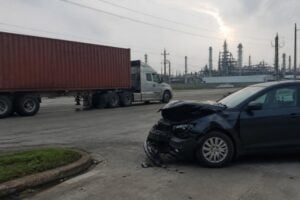
Pasadena, Texas runs on trucks. The refineries and chemical plants along the Houston Ship Channel, and the Bayport and Barbours Cut container terminals just down SH 146, put tankers, container haulers, flatbeds and dump trucks on SH 225 and Beltway 8 around the clock. When one of those trucks hits a car, the trucking company has a lawyer and an adjuster working within hours, and most of the evidence belongs to the company.
Call (713) 664-4000. The consultation is free, and there’s no fee unless we recover for you. If we don’t recover, you don’t owe us for case expenses either. If the trucking company or its insurer calls you, don’t give a statement until you’ve talked to us.
Plant and port trucks on SH 225
SH 225 is the main road between the plants and the rest of Houston. Beltway 8 crosses it in the middle of Pasadena, and the tollway bridge over the Ship Channel brings trucks down onto it from the north. SH 146 carries container traffic between the port terminals and I-10, and Red Bluff Road, Richey Street, Spencer Highway and Fairmont Parkway put those same trucks next to neighborhood traffic and school zones. Container chassis with bad brakes, tankers that roll in a turn, loads that shift or fall and trucks making wide right turns across two lanes cause a lot of the wrecks we see.
Pasadena police work crashes inside the city, and Harris County deputies and constables work the unincorporated areas around it. Whoever wrote the report, it’s the first thing the insurer reads, and it’s often wrong about who had the right of way. We check it against the photos, the damage, the witnesses and the truck’s own data.
Truck data that won’t be there for long
Port cases come with their own paper trail: the chassis owner’s inspection and repair records under the federal intermodal equipment rules (49 C.F.R. Part 390, Subpart C), the terminal’s gate timestamps, the drayage company’s dispatch log and the container’s weight ticket. The truck keeps its own record too, with the engine control module logging speed and braking before impact and the electronic logging device tracking the driver’s hours. Plenty of trucks run forward-facing cameras too, and the carrier’s dispatch records show what schedule the driver was on. Federal rules only make the company keep the hours records for six months (49 C.F.R. § 395.8), and camera footage can be overwritten well before that. Our preservation letter goes out in the first week. If the company stalls, we ask a court to order it.
A driver generally can’t drive more than 11 hours after 10 hours off duty under federal rules (49 C.F.R. § 395.3), and a driver who never leaves Texas gets 12 hours after 8 off (37 Texas Administrative Code § 4.12). After a fatal crash, or one where the driver gets a ticket and someone is taken for treatment or a vehicle is towed, the carrier has to test the driver for drugs and alcohol (49 C.F.R. § 382.303).
Port container cases and bigger policies
A Pasadena truck case often has more than one defendant: the driver and the carrier he drove for, plus the shipper that loaded the trailer and the company that owned or maintained the chassis. Port container cases can involve three or four companies before we even get to the insurers.
The coverage is bigger than a car’s. A for-hire interstate carrier hauling general freight has to carry at least $750,000 (49 C.F.R. § 387.9). Carriers hauling hazardous materials, which describes a lot of the tankers leaving the plants, have to carry $1 million or $5 million depending on the cargo (same section). A carrier that only operates inside Texas has to carry $500,000 for most heavy trucks (43 Texas Administrative Code § 218.16).
Since 2021, if a trucking defendant asks in time, Texas splits the trial in two. Fault and compensatory damages get decided first, and punitive damages come in a second phase (Civil Practice and Remedies Code § 72.052). A company that admits the driver was working for it can keep most of its hiring history out of that first phase. A driver over his hours, a drug or alcohol violation, a missing medical card and a truck the company didn’t maintain can all still come in, though (§ 72.054). So the case against the driver has to stand on its own, and we put the company’s violations in front of the jury right alongside it.
Where the case gets filed and where you get treated
A Pasadena wreck is a Harris County case, and if it’s filed in state court, it goes to the civil courthouse at 201 Caroline in downtown Houston. An out-of-state carrier may try to move it to federal court in Houston. Serious injuries from Pasadena go to HCA Houston Healthcare Southeast or Memorial Hermann Southeast, both Level III trauma centers, and the worst go to the Level I trauma centers in the Texas Medical Center.
The clock to file suit generally runs two years from the crash (Civil Practice and Remedies Code § 16.003), but the evidence won’t last nearly that long.
A truck case we resolved for $2.95 million
In a rear-end case against a commercial truck driver who was following too closely, we recovered a $2.95 million settlement for our client. See all of our settlements and verdicts. Prior results do not guarantee a similar outcome.
Hurt by a plant or port truck? Call us
Jay Blass Cohen has been practicing in Houston since 2009. We prepare every truck case as if it’s going to trial, starting with the evidence the company would rather lose. For more on how these cases work, see our Houston 18-wheeler accident page. If a car hit you in Pasadena, see our car accident page.
Call (713) 664-4000. If the crash was this week, call now, before the truck’s data gets overwritten.
Reviewed by Jay Blass Cohen, founder of Blass Law PLLC, ACS-CHAL Forensic Lawyer-Scientist, certified Drug Recognition Expert, and SFST instructor, serving Houston since 2009. This article is general information, not legal advice for your situation. Prior results do not guarantee a similar outcome.