
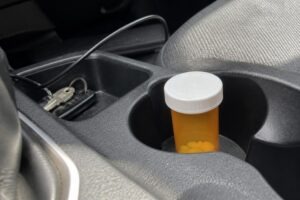
Yes. In Texas you can be charged with DWI for driving on a prescription you took exactly as your doctor wrote it. The statute doesn’t care whether the drug was legal. It asks whether you’d lost the normal use of your mental or physical faculties, and the prescription itself is no defense.
These cases are also the hardest DWIs for the State to prove, because there’s no legal limit for a drug the way there is for alcohol. Call (713) 664-4000. A drug DWI is usually won or lost on the science, and that’s where we live.
What the law says
Penal Code § 49.01(2) defines “intoxicated” two ways. The first is not having the normal use of your mental or physical faculties because of alcohol, a controlled substance, a drug, a dangerous drug, a combination of them, or “any other substance.” The second is an alcohol concentration of 0.08 or more. That 0.08 number applies only to alcohol. Nothing in Texas law sets a per se limit for any other drug.
Then § 49.10 closes the door people usually reach for first: in a DWI prosecution, “the fact that the defendant is or has been entitled to use the alcohol, controlled substance, drug, dangerous drug, or other substance is not a defense.” A valid prescription for Xanax or Ambien doesn’t answer the charge. It just moves the fight to whether the drug actually impaired you.
Which drugs lead to DWI charges
Any substance can, if the State can show it took away the normal use of your faculties. The ones we see most:
- Benzodiazepines like alprazolam (Xanax), clonazepam and diazepam
- Sleep drugs like zolpidem (Ambien)
- Opioid pain medications like hydrocodone, oxycodone and tramadol
- Muscle relaxers like carisoprodol (Soma) and cyclobenzaprine
- Over-the-counter antihistamines, especially diphenhydramine, the active ingredient in Benadryl and most “PM” sleep aids
- Marijuana and THC products
- Illegal drugs like cocaine and methamphetamine
Combinations are where most of these cases start. A driver blows well under 0.08, the officer still thinks something is off, and a blood draw comes back with a small amount of alcohol plus a prescription. The State then argues the two together did what neither did alone. The statute’s “combination of two or more of those substances” language lets it.
How the State tries to prove impairment
With no number to point to, the State leans on what the officer saw and on a Drug Recognition Expert. The first part is the driving and the roadside, usually on video. The second is the DRE evaluation, a structured 12-step exam done at the station by an officer trained to decide which category of drug is causing the impairment. The blood result comes later and gets its own section below.
Jay Blass Cohen is a certified Drug Recognition Expert himself. He’s been through the same training the evaluating officer went through, and he reads a DRE face sheet looking for skipped steps and for conclusions the officer reached before the data supported them.
A blood result shows presence, not impairment
This is the center of most drug DWI defenses. A lab can tell you that a drug was in your blood and how much. It can’t tell you that the amount impaired you. People on long-term prescriptions build tolerance, and a level that would put a new patient to sleep may be an ordinary Tuesday for someone who has taken the same dose for five years. Some substances, THC above all, linger in blood long after any effect is gone.
The lab work itself also has weak points. A screening test is not a confirmation test. A result has to be confirmed by a method like chromatography with mass spectrometry, run and documented correctly, with a chain of custody from the draw to the instrument. Jay is an ACS-CHAL Forensic Lawyer-Scientist trained in forensic chromatography, which means the lab packet in your case gets read by someone who knows how it was produced and where it can go wrong.
The penalties are the same as any DWI
A drug DWI is charged under the same statute and graded the same way as an alcohol DWI. A first offense is a Class B misdemeanor under § 49.04(b), with a 72-hour minimum, up to 180 days in jail and a $2,000 fine. A second is a Class A with a 30-day minimum, and a third is a third-degree felony. A child passenger younger than 15 makes it a state jail felony under § 49.045, as does a school crossing zone under § 49.04(e). The 0.15 enhancement under § 49.04(d) is the one piece that can’t apply, because it’s defined by an alcohol concentration.
A conviction also brings a license suspension of 90 days to a year on a first offense under Transportation Code § 521.344, and the $3,000 state fine under § 709.001. Our pages on what a DWI costs and when a DWI becomes a felony cover those in detail.
What to do if you were arrested
Don’t explain your prescriptions to the officer, and don’t list what you took or when. It won’t talk you out of the arrest, and every word ends up in the report. The prescription can help you later, in the right way, when your lawyer decides how to use it.
Request your ALR hearing within 15 days of the notice. A drug case often involves a refusal or a blood warrant, and the hearing is the first chance to question the officer and, sometimes, the DRE under oath.
Write down everything you remember about the day: what you took and when, what you ate, how much you slept, and anything unusual about how you felt. Timing matters in these cases more than in any other DWI.
Charged with DWI on prescription drugs in Houston? Call Blass Law
Drug DWIs are the cases where training on the defense side matters most. Jay has defended DWI cases in Harris County since 2009 and has only ever been a defense lawyer, and he’s certified in the same Drug Recognition Expert protocol the State relies on. Our Houston DWI on prescription drugs lawyer page covers how we handle them.
Call (713) 664-4000. Bring your prescription bottles and the paperwork the officer gave you.

A Houston DWI and criminal defense attorney since 2009 who has never worked for the prosecution. Jay is an ACS-CHAL Forensic Lawyer-Scientist, a certified practitioner and instructor of Standardized Field Sobriety Testing, a certified Drug Recognition Expert, and trained in forensic chromatography. He is a member of the National College for DUI Defense, a founding member of the DUI Defense Lawyers Association, and a commissioner on the Texas Indigent Defense Commission, appointed by Gov. Abbott in 2023.
Last reviewed September 2026 · This article is legal information, not legal advice. Read Jay’s full bio →