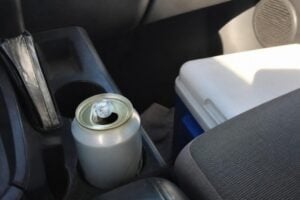
Texas makes it a crime to have an open container of alcohol in the passenger area of a vehicle on a public road. You don’t have to be drunk, and you don’t have to be driving. A sober passenger holding a half-finished beer in a parked car on the shoulder of the road can be cited. The State does have to prove you knew the container was there, so a passenger who didn’t know about a can under someone else’s seat has a defense. On its own, open container is a Class C misdemeanor, a fine-only offense with a maximum of $500, and the officer has to write you a ticket and release you once you sign it instead of taking you to jail (Penal Code § 49.031(d), (e)).
Where it gets serious is when an open container shows up in a DWI case. Every open container charge we handle comes attached to a DWI, and the container changes the punishment on the DWI.
What counts as an open container
The statute defines it as any bottle or can (or other container) that holds any amount of an alcoholic beverage and is open, has been opened, has a broken seal, or has had some of its contents removed (§ 49.031(a)(1)). A bottle of wine you opened at dinner and recorked is an open container. So is a liquor bottle with the cap screwed back on tight. A sealed bottle with the seal intact is not, and you can carry it anywhere in the car as long as you’re 21 or older.
Where in the car it matters
For a legal consultation, call (713) 664-4000
The offense covers the “passenger area,” which the law defines as the part of the vehicle designed for the driver and passengers to sit (§ 49.031(a)(2)). Cupholders, the floorboard, the back seat and an unlocked center console all count. A locked glove compartment or a similar locked compartment doesn’t, and neither does the trunk.
If the vehicle has no trunk, like an SUV or a hatchback, the law excludes the area behind the last upright row of seats instead.
So the open bottle from the party goes in the trunk or the cargo area behind the back seat. An unlocked glove box doesn’t protect you.
The road versus the parking lot
The vehicle has to be on a “public highway,” which the statute defines as the full width of any publicly maintained road open to motor vehicle traffic, including the right-of-way (§ 49.031(a)(3)). That covers everything from a cul-de-sac to I-10. And the offense applies even when the vehicle is parked on that road.
DWI uses a different test. It only requires a “public place,” meaning anywhere the public or a substantial group of the public has access (Penal Code § 1.07(a)(40)). A mall parking lot is a public place, and so is the lot outside a bar or an apartment complex.
Can passengers drink in a moving car?
No, with two exceptions. The law applies to anyone who knowingly has an open container in the passenger area, not only the driver. A passenger who’s sipping a drink while a sober friend drives is committing the offense.
Click to contact our Houston lawyer today
The exceptions are narrow, and both apply only to passengers (§ 49.031(c)). The first is a vehicle designed, maintained or used mainly to carry paying passengers, like a bus, a taxi or a limousine. That’s why passengers on a party bus or in a wedding limo can drink. Whether a rideshare driver’s personal car qualifies is an open question, because the exception depends on whether that car is used mainly for paid rides, and that changes from driver to driver. We wouldn’t bet a charge on it.
The second is the living quarters of an RV or motor home. That exception also covers only passengers. The driver never qualifies, and we’d treat the front passenger seat of an RV like any other car. Keep the drinks in the back.
How an open container makes a DWI worse
Complete a Case Evaluation form now
A first DWI is a Class B misdemeanor, and if the judge sends you to jail, the minimum is 72 hours. If the State proves you had an open container in your immediate possession while driving, that jail minimum becomes six days (Penal Code § 49.04(c)). It’s still a Class B, but prosecutors use the open container allegation as a bargaining chip in plea talks.
“Immediate possession” is the phrase that matters. An open can rolling around under the back seat is a different case from a cup in the driver’s hand, and the video from the stop often shows which one it was. We look at where the container was found and whether the officer’s report matches the footage. When it doesn’t match, the open container allegation is the first thing we attack.
Facing a DWI with an open container allegation? Start with our Houston DWI defense practice. If a passenger was also charged, we cover how passenger cases work separately.
What we handle, and what we don’t
An open container ticket by itself goes to municipal or justice court as a fine-only offense, and we don’t handle those. We come in when the open container is part of a DWI, because then it raises the jail minimum and hands the prosecutor something to bargain with.
Our Houston open container lawyers fight the open container allegation as part of the DWI defense, working from the same stop and the same video. Call Blass Law at (713) 664-4000 or reach out through our site. The consultation is free.
Call or text (713) 664-4000 or complete a Case Evaluation form