
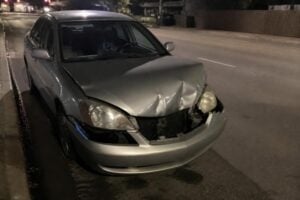
After an Uber or Lyft crash, how much insurance is available depends on something you probably can’t see: what the driver’s app was doing at the moment of impact. If a passenger was in the car, or the driver had accepted a ride and was on the way to pick someone up, Texas requires $1 million in liability coverage. If the driver was logged in and waiting for a request, the required coverage drops to $50,000 per person. If the app was off, it’s just the driver’s personal policy, and the Texas minimum there is $30,000 per person. Figuring out which of those applies, and locking down the proof before the phone data and nearby video disappear, is the first thing we do in a rideshare case.
Call (713) 664-4000. Don’t give a recorded statement to the rideshare company’s insurer, or to the driver’s own insurer, before you talk to us.
Rideshare insurance in Texas
| What the driver was doing | Minimum coverage required |
|---|---|
| App off, driving on their own | The driver’s personal auto policy. Texas minimum: $30,000 per person, $60,000 per crash, $25,000 property damage |
| Logged in and available, no ride accepted | $50,000 per person, $100,000 per crash, $25,000 property damage (Insurance Code § 1954.052) |
| Ride accepted, on the way to pick up, or carrying a passenger | $1 million total for injury, death and property damage per incident (§ 1954.053) |
Most personal auto policies exclude coverage while the driver is logged in or on a ride, and Texas law allows that (§ 1954.151). So once the app is on, the rideshare company has to provide the coverage from the first dollar if the driver’s policy lapsed or doesn’t cover it (§ 1954.054). The company’s coverage also can’t be held back until the personal insurer denies the claim (§ 1954.055). If someone asks after a crash, the driver has to say whether they were logged in or on a ride (§ 1954.056). We don’t take the driver’s word for it. The company and its insurer have to hand over the exact times the driver logged on and off in the 12 hours before and after the crash, along with the policy’s coverage and limits (§ 1954.154). That app status and GPS data sits with the company, not the driver.
If you were the passenger
Passengers are almost never at fault, so the real fight usually isn’t whether you have a claim. It’s whose insurance pays and in what order. If your driver caused the crash, the $1 million policy applies. That $1 million is one pot for everyone hurt in the crash, plus the property damage, so in a crash with several injured people it can go fast. If another driver caused it, that driver’s insurer is responsible first, and many of them carry only the Texas minimum. Then the question becomes whether the rideshare policy includes uninsured or underinsured motorist coverage, and how much. Texas lets companies reject that coverage in writing, so we get the actual policy instead of assuming. Your own auto policy may help too, since personal injury protection and underinsured motorist coverage can follow you as a passenger in someone else’s car, unless you turned them down in writing.
If a rideshare driver hit you
Pedestrians, cyclists, motorcyclists and other drivers hit by an Uber or Lyft driver face the same question about app status. A driver looking at the app, or cutting across lanes to grab a pickup, is a common story in Midtown, Montrose, downtown and around the airports. The difference between the $50,000 tier and the $1 million tier can come down to a few seconds of data, and we send a preservation demand to the company right away.
If you drive for Uber or Lyft
Texas law treats rideshare drivers as independent contractors for all purposes as long as the company doesn’t set their hours, limit their territory, stop them from driving for other apps or keep them from working another job, and they’ve signed an agreement saying so (Occupations Code § 2402.114). That usually means no workers’ compensation. If another driver hit you, your claim is against that driver’s insurance, and the uninsured motorist coverage on the rideshare policy, if the company carries it, may apply when the other driver has too little. Your personal policy’s rideshare exclusion is worth reading closely before anyone tells you there’s no coverage.
Can you sue Uber or Lyft?
Usually the claim runs against the driver and the rideshare insurance Texas law requires, not against the company for the driver’s negligence. Texas law says the companies don’t control their drivers except as they agree in writing (Insurance Code § 1954.102). Claims against the company itself are possible in narrower situations, such as a driver who should never have passed the background and driving record checks the law requires (Occupations Code § 2402.107). Uber’s and Lyft’s rider terms both push injury claims against the company into private arbitration with no jury, and Uber’s reach people riding on someone else’s account too. Whether that clause can be enforced against you is one of the first things we look at. See whether you can sue Uber or Lyft directly.
Deadlines and fault
You have two years from the crash to file suit in most cases (Civ. Prac. & Rem. Code § 16.003). Texas uses proportionate responsibility: you can recover as long as you were not more than 50 percent at fault, and your recovery is reduced by your share (§§ 33.001, 33.012). If you were admitted to a hospital within 72 hours of the crash, the hospital can file a lien against your recovery, capped at half of what you recover, and how that gets negotiated changes what you take home (Property Code ch. 55). See our page on hospital liens in Texas.
Hurt in an Uber or Lyft crash in Houston? Call Blass Law
Jay Blass Cohen has practiced in Houston since 2009. We’ll lock down the trip data and find every policy that applies. You focus on getting better. For other crash cases, see our Houston car accident lawyer page.
Call (713) 664-4000. If the crash just happened, call today, before the rideshare company’s insurer calls you.
Real Results for Our Clients
Prior results do not guarantee a similar outcome. See all case results →
Related Personal Injury Practice Areas
- Houston Personal Injury Lawyer (Overview)
- Car Accident Lawyer
- Truck Accident Lawyer
- Drunk Driving Accident Lawyer
- Maritime & Admiralty Accident Lawyer
- Premises Liability Lawyer
- Wrongful Death Lawyer
- Medical Malpractice Lawyer
- Product Liability Lawyer
- Bicycle Accident Lawyer
- Catastrophic Injury Lawyer
- Burn Injury Lawyer
- Construction and Workplace Injury Lawyer
- Settlements & Verdicts
Frequently Asked Questions
- Who Is Liable If I’m Injured in an Uber or Lyft Accident in Texas?
- What If the Rideshare Driver Was Not at Fault for My Accident?
- Can I Sue Uber or Lyft Directly After an Accident?
- How much can a hospital take from my settlement?
Reviewed by Jay Blass Cohen, founder of Blass Law PLLC, ACS-CHAL Forensic Lawyer-Scientist, certified Drug Recognition Expert, and SFST instructor, serving Houston since 2009. This article is general information, not legal advice for your situation. Prior results do not guarantee a similar outcome.