
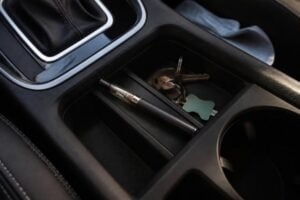
In Texas, a THC vape cartridge is a felony. The same high, in plant form, at the same weight, is a Class B misdemeanor. That is not a typo and it is not a technicality, it is how the statute is written, and it catches people who had no idea they were doing anything more serious than carrying a joint.
If you have been arrested with a cart, a dab pen or wax in Harris County, call Blass Law at (713) 664-4000. There is a real defense in these cases and it has a shelf life.
Is a THC Cartridge a Felony in Texas?
Yes. Possession of any amount is at minimum a state jail felony, which carries 180 days to two years in a state jail facility and a fine up to $10,000.
The ladder comes from Health and Safety Code § 481.116, and it is measured by aggregate weight including adulterants or dilutants:
| Aggregate weight | Offense | Range |
| Less than 1 gram | State jail felony | 180 days to 2 years |
| 1 gram to under 4 grams | Third degree felony | 2 to 10 years |
| 4 grams to under 400 grams | Second degree felony | 2 to 20 years |
| 400 grams or more | First degree felony | 5 to 99 years or life, fine up to $50,000 |
Compare that to marijuana under § 481.121: two ounces or less is a Class B misdemeanor, and it takes more than four ounces before you are looking at a felony at all. Two ounces is roughly 56 grams. One gram of cart oil is a third degree felony. Same plant, same chemical, fifty-six times the weight on the misdemeanor side.
Why the Law Treats a Cart Worse Than Flower
Because of one phrase in a definition almost nobody reads.
§ 481.002(26) defines marihuana as the Cannabis sativa L. plant and its seeds and preparations, then carves out, at subsection (A), “the resin extracted from a part of the plant or a compound, manufacture, salt, derivative, mixture, or preparation of the resin.”
Cart oil is extracted resin. So it is not marihuana, legally speaking. And once it is not marihuana it falls into the Penalty Group 2 entry in § 481.103, which reads “Tetrahydrocannabinols, other than marihuana.” Penalty Group 2 possession starts at a state jail felony with no misdemeanor tier underneath it.
Wax, shatter, live resin, RSO, dabs and edibles made from concentrate all land in the same place for the same reason.
How They Weigh It, and Why That Number Is Not What You Think
This is where good people end up charged with a third degree felony over a gram of liquid.
§ 481.002(5) defines a controlled substance to include an adulterant and a dilutant, and says the term “includes the aggregate weight of any mixture, solution, or other substance containing a controlled substance.”
A cartridge is mostly not THC. It is oil, terpenes, and often a cutting agent. None of that matters to the weight. The whole liquid gets weighed, so a cart sold as “1 gram” is at or over the line into the third degree felony bracket at 1 gram, and two of them in a center console is a 2-gram case.
What the statute does not count is the hardware. The battery, the housing and the mouthpiece are not the substance, and whether the lab weighed oil or oil plus device is a question worth asking every time. Labs get this wrong, and the difference between 0.9 grams and 1.1 grams is the difference between a state jail felony and a third degree felony.
The Hemp Problem, Which Is the Defense
In 2019 the Legislature passed House Bill 1325 and made hemp legal. Agriculture Code § 121.001 defines hemp as Cannabis sativa L. and any part of that plant, including all derivatives, extracts, cannabinoids, isomers, acids and salts, with a delta-9 THC concentration of not more than 0.3 percent on a dry weight basis.
Then the Legislature wrote that straight into the drug code. § 481.002(5) says the term controlled substance “does not include hemp, as defined by Section 121.001, Agriculture Code, or the tetrahydrocannabinols in hemp.”
Read those together and the consequence is blunt: cannabis oil is only a controlled substance if its delta-9 concentration is above 0.3 percent, and the State has the burden of proving that. Not that it smelled like marijuana. Not that the officer field-tested it. A quantitative laboratory result.
That is why DPS told officers in 2019 to cite rather than arrest on low-level marijuana, and why district attorneys across Texas dropped thousands of cases. The testing capacity problem was real, and in concentrate cases it has never fully gone away, because quantifying delta-9 in an oil is harder than identifying a plant.
Delta-8 carts make it messier still. The hemp definition expressly covers cannabinoids and isomers. The case for delta-8 rests on that language, and whether a particular delta-8 product sits inside or outside it has been fought over in Texas courts for years. If you bought a cart over the counter at a smoke shop believing it was legal, that belief is not the point. What the lab can prove about delta-9 concentration is.
The Pen Itself Is a Separate Charge
Under § 481.125(a) and (d), possessing drug paraphernalia to inhale a controlled substance is a Class C misdemeanor, fine only, no jail. On its own it is the least of your problems. It matters because a paraphernalia charge is sometimes what a felony gets negotiated down to, and because it is one more thing on a record that has to be cleared later.
What to Do if You Are Caught with a THC Pen
Four things, and the first one covers most of it.
Say nothing about the pen
You are not required to answer questions about what is in the cartridge, where you got it, whose it is, or how long you have had it. Not on the roadside, not in the back of the car, not at the station.
Identity is the narrow exception and it is narrower than people think. Under Penal Code § 38.02(a), you only have to give your name, address and date of birth after you have been lawfully arrested. On a detention short of arrest, declining to identify yourself is not an offense, but if you were driving, you do have to show your license when an officer asks (Transportation Code § 521.025). Your phone number is not on that list at all.
Do not lie about it
Texas has no offense called obstruction of justice, but it does have Penal Code § 37.08: knowingly making a false statement material to a criminal investigation, with intent to deceive, to the officer conducting it, is a Class B misdemeanor. Giving a false name is its own Class B under § 38.02(b). Silence is free. A story is a second charge.
Do not consent to the search
If an officer asks permission, that request is an admission he may not already have the right. Saying no is not evidence of anything and it does not make you look guilty in front of a judge. It preserves an argument that a lawyer can use later, and in cart cases the stop and the search are frequently where the case falls apart.
Call a lawyer before you do anything else
The evidence that helps you has a clock on it. Dash and body camera footage gets overwritten. So does the store’s video if you bought the cart legally over the counter and can prove what the label said. And the lab result, which is the entire case, has to be requested and then actually read by somebody who understands chromatography.
If you were driving when they found it, the case gets a second front, because a THC DWI is charged on impairment rather than a number. See our Houston DWI marijuana and THC lawyer page.
How Long Does the State Have to Charge You?
Three years for a felony, under Code of Criminal Procedure Art. 12.01(11), and two years for a misdemeanor under Art. 12.02. That is the window to present a charge, not a deadline to try the case, and a delay in filing does not mean the case went away. People get indicted on cart cases a year after the arrest, long after they assumed nothing was happening.
Talk to a Houston Drug Defense Lawyer
Jay Blass Cohen has defended criminal cases in Harris County since 2009 and has never worked for the other side. He is trained in forensic chromatography, which is the exact discipline the State’s lab uses to say what is in that cartridge and at what concentration. On a case that turns entirely on a lab number, that matters more than it sounds like it should.
Call (713) 664-4000 or use our contact form. Bring the packaging if you still have it. You can also read about how we handle drug possession cases.

A Houston DWI and criminal defense attorney since 2009 who has never worked for the prosecution. Jay is an ACS-CHAL Forensic Lawyer-Scientist, a certified practitioner and instructor of Standardized Field Sobriety Testing, a certified Drug Recognition Expert, and trained in forensic chromatography. He is a member of the National College for DUI Defense, a founding member of the DUI Defense Lawyers Association, and a commissioner on the Texas Indigent Defense Commission, appointed by Gov. Abbott in 2023.
Last reviewed September 2026 · This article is legal information, not legal advice. Read Jay’s full bio →