
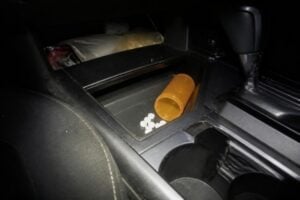
In Harris County, the charge on your paperwork probably says “possession of a controlled substance,” or PCS. What it actually means depends on two facts: which penalty group the drug falls in, and what the lab says it weighed. A crumb of cocaine or a pill of oxycodone without a prescription is a state jail felony. The same weight of Xanax is a misdemeanor. Where it happened can matter too. The same crumb within 1,000 feet of a school or playground is a third-degree felony (§ 481.134), and in Houston that covers a lot of ground. There’s no minimum amount for most drugs, so even residue the lab can identify and weigh can support a felony, although with tiny amounts the State has a harder time proving you knew it was there.
Call (713) 664-4000. Don’t explain to the officer or anyone on a jail phone where the drugs came from. Jail calls are recorded.
How PCS is graded in Texas
| Penalty group | Examples | Possession grading |
|---|---|---|
| 1 and 1-B (§ 481.115) | Cocaine, meth, heroin, oxycodone, fentanyl | Under 1 g: state jail felony. 1 to 4 g: third degree. 4 to 200 g: second degree. 200 to 400 g: first degree. 400 g or more: 10 to 99 years or life |
| 1-A (§ 481.1151) | LSD | Graded by abuse units. Fewer than 20: state jail felony, rising to 15 to 99 years at 8,000 or more |
| 2 (§ 481.116) | MDMA, mushrooms, THC vape oil and wax | Under 1 g: state jail felony. 1 to 4 g: third degree. 4 to 400 g: second degree. 400 g or more: 5 to 99 years or life |
| 3 (§ 481.117) | Xanax, Valium, Klonopin and most other benzodiazepines, and hydrocodone combination pills like Norco | Under 28 g: Class A misdemeanor. 28 to 200 g: third degree. 200 to 400 g: second degree. 400 g or more: 5 to 99 years or life |
| 4 (§ 481.118) | Low-dose codeine compounds | Under 28 g: Class B misdemeanor, then the same felony scale as Group 3 |
All of these are Health and Safety Code sections, and the weight is the aggregate weight, “including adulterants or dilutants.” The whole pill counts, not just the drug in it. A few oxycodone or ecstasy pills can cross the 1-gram line and turn a state jail felony into a third-degree felony with a 2-to-10-year range. Prescription drugs that aren’t on the controlled substance lists fall under the dangerous drug law, and possessing one without a prescription is a Class A misdemeanor (§ 483.041). Our page on Texas drug penalty groups lists what’s in each group.
Most PCS cases are state jail felonies
A state jail felony carries 180 days to 2 years in a state jail and up to a $10,000 fine. If it’s your first felony conviction and the case isn’t enhanced, the judge has to give you probation instead of a state jail sentence for most small-amount possession cases, though the judge can make 90 to 180 days in a state jail facility a condition of that probation (Code of Criminal Procedure Art. 42A.551, 42A.555). That protection disappears if you take deferred adjudication and it gets revoked. At that point the judge can send you to state jail, which is one reason we weigh a deferred offer carefully before you sign it. A judge can also sentence a state jail felony to county jail time under Penal Code § 12.44(a), but that’s still a felony conviction. Only the place and length of confinement change. Getting the charge itself reduced to a Class A misdemeanor takes the prosecutor’s request and the judge’s approval under § 12.44(b), or a plea to a lesser charge, and that’s something we negotiate. Our page on whether first-time drug offenders go to jail covers these options.
Texas also has an overdose defense. If you were the first person to call for help during someone else’s overdose and stayed and cooperated, or you were the one who overdosed, it’s a defense to the lowest level of possession in every penalty group, including misdemeanor pills (§ 481.115(g) and the matching sections for the other groups). It doesn’t apply if you had a prior drug conviction or deferred, if you’d called for overdose help in the last 18 months, if you were committing some other crime at the time, or if police were already arresting you or executing a search warrant when the call was made.
How we defend possession of a controlled substance
The search. Most PCS cases start with a traffic stop or a consent search. If the stop wasn’t legal, or the officer searched without a warrant or a recognized exception to the warrant requirement, the drugs can be suppressed. Without them there’s no case. See what grounds police need for a drug search.
Knowledge and control. The State has to prove you knew the drugs were there and exercised control over them. A baggie under the passenger seat of someone else’s car, or residue in a pipe in a shared living room, doesn’t prove that by itself. The State needs additional facts tying the drugs to you, and when it doesn’t have them, we make it say so in front of a judge. See the legal definition of possession.
The lab. A roadside field test kit isn’t proof. The lab has to identify the substance and weigh it, and the charge depends on that weight landing on the right side of a line. Jay Blass Cohen is an ACS-CHAL Forensic Lawyer-Scientist trained in forensic chromatography, so we read the instrument data, the calibration records, the chain of custody and the analyst’s notes, not just the one-page report.
Your prescription. The possession statutes don’t apply if you got the drug directly from or under a valid prescription. Carrying your own prescribed pills in a pill case or a baggie isn’t a crime in Texas. It still gets people arrested, and it’s on you to show the prescription, which is exactly what we do to get those cases dismissed. Having someone else’s pills isn’t covered. And hydrocodone pills like Norco and Vicodin are Penalty Group 3 in Texas, not Group 1, so when a Norco case under 28 grams gets filed as a felony, that’s the first thing we fix.
Keeping it off your record
A dismissal after pretrial intervention can be expunged. Deferred adjudication can’t be expunged, but it can be sealed with an order of nondisclosure. On a misdemeanor PCS, like a small amount of Xanax, you’re eligible as soon as the deferred is discharged, and if it’s your first offense, the judge has to grant it. On a felony, you wait five years after discharge and petition the court. A felony PCS conviction, even one where the judge gave county jail time under § 12.44(a), can’t be sealed except in narrow cases like veterans treatment court, and a pardon opens the door to expunction instead. A reduction to a Class A misdemeanor under § 12.44(b) can become eligible for nondisclosure two years after the sentence ends. That’s why we look at the record consequences of every offer before we recommend one. See our pages on expunctions and orders of nondisclosure.
Results
A Harris County client stopped for driving on the light rail tracks was charged with DWI, second offense, and possession of a controlled substance. Both charges were dismissed in the middle of trial. See more of our case results. Prior results do not guarantee a similar outcome.
Charged with possession of a controlled substance in Houston? Call Blass Law
Jay Blass Cohen has defended drug cases in Houston since 2009 and has never worked for the prosecution. We’ll look at how the police found the drugs and what the lab actually reported before we talk about any plea. For other drug charges, see our Houston drug charges page.
Call (713) 664-4000. If you were arrested this week, call now, while the stop video is still easy to get.
Reviewed by Jay Blass Cohen, founder of Blass Law PLLC, ACS-CHAL Forensic Lawyer-Scientist, certified Drug Recognition Expert, and SFST instructor, serving Houston since 2009. This article is general information, not legal advice for your situation. Prior results do not guarantee a similar outcome.